Sizing and radiation
Size subsonic flares to a target allowable radiation and optionally include solar radiation.
Industrial engineering · safety
Size industrial flares, calculate flue-gas composition, and evaluate thermal and acoustic impact with recognized engineering methodologies.
Engineering scope
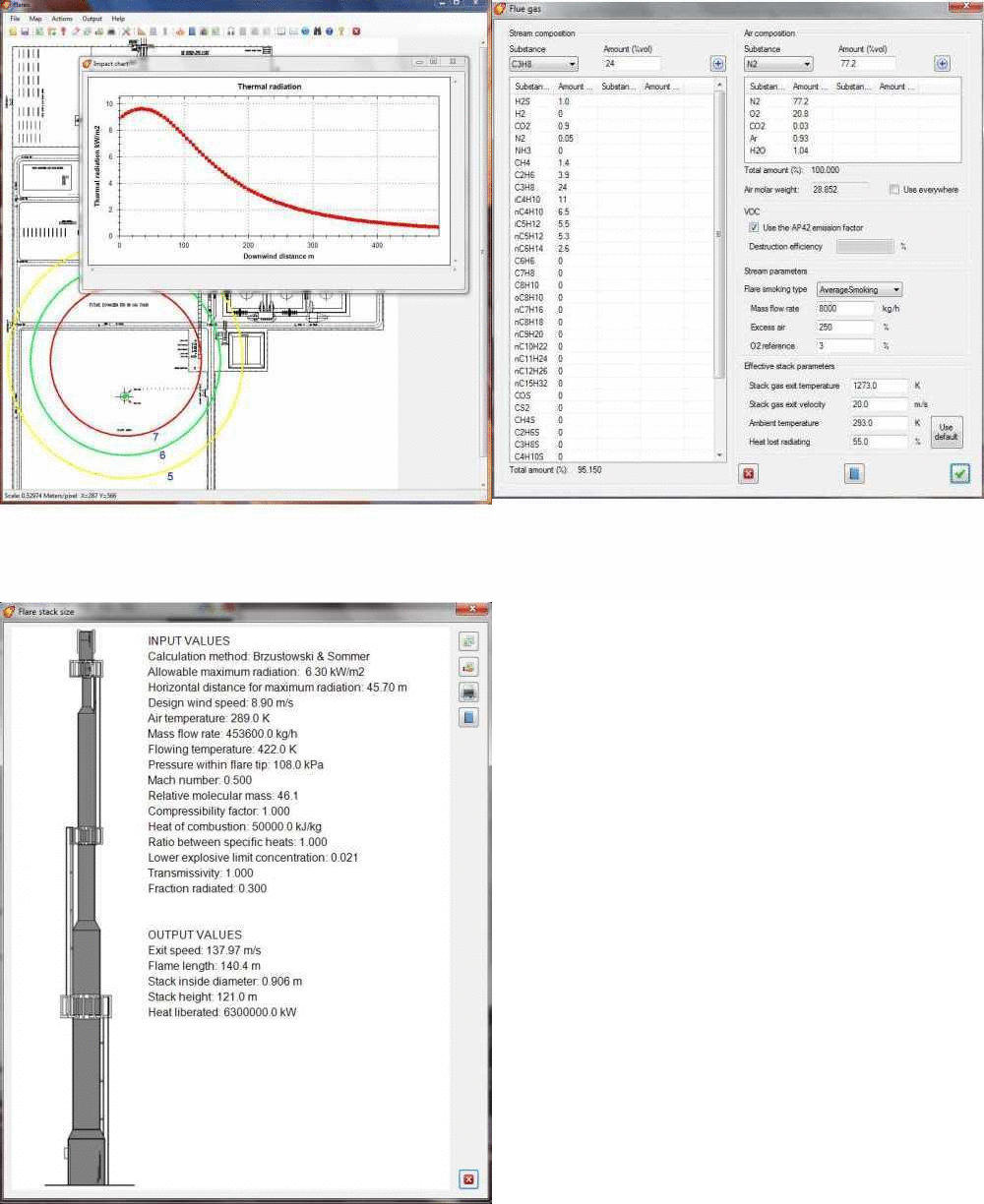
FLARES combines engineering calculations with georeferenced impact mapping, making it easier to compare design choices and communicate consequences at specific locations.
The software handles subsonic flare sizing, thermal radiation, noise, flue-gas composition, and effective source parameters for atmospheric dispersion modeling. SI and United States Customary units are supported.
Load a digital base map, position the flare, and inspect radiation or acoustic levels at any point. Maps and textual outputs can be copied, saved, printed, or incorporated into technical reports.
Determine flare height and diameter for an allowable radiation level.
Evaluate combustion products, radiation, noise, and flame behavior.
Georeference the stack and display impact levels spatially.
Create report-ready graphics, ASCII results, and KML layers.
Capabilities
Size subsonic flares to a target allowable radiation and optionally include solar radiation.
Calculate thermal radiation and acoustic levels for subsonic and sonic cases.
Calculate flue-gas composition from the specified release mixture.
Estimate effective source parameters using US EPA SCREEN3 and TCEQ methods.
Apply the simple approach or the Brzustowski and Sommer method.
Work consistently with SI or United States Customary units.
Load a base map, use world files when available, and position the flare graphically.
Read radiation and noise values while moving over the mapped project area.
Export stacks and impact contours to Google Earth and reuse graphics in reports.
Methods and standards
Method selection depends on the requested output and flare regime.
Download the Windows evaluation package and review sizing, impact, and mapping workflows.
Download evaluation →Current subscription pricing and terms are available through FastSpring. Active subscriptions include software updates.
Subscription options →Need a site-specific assessment?
We support flare characterization, dispersion studies, thermal impact, acoustics, and technical reporting.